
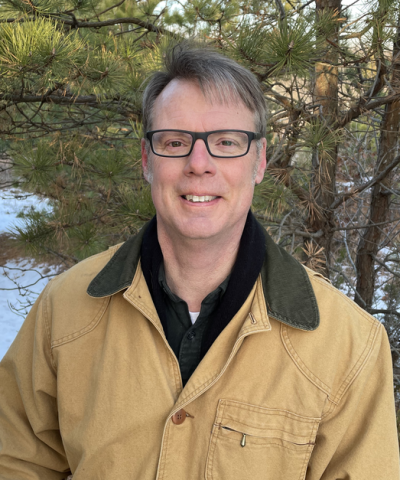
Biography
Alan Calder is a professor in the Astronomy Group within the Department of Physics and Astronomy, and a core faculty member of the Institute for Advanced Computational Science at Stony Brook University. His research is in nuclear astrophysics and involves simulating explosive astrophysical phenomena, with extensive use of large-scale computing.
Before Stony Brook he held research appointments at the National Center for Supercomputing Applications and at the University of Chicago, where he worked at the Center for Astrophysical Thermonuclear Flashes. He also taught at the School of the Art Institute of Chicago.
Research
His astrophysics research centers on Type Ia supernovae, the bright stellar explosions that produce and disperse heavy elements and therefore shape galactic chemical evolution. Because their light curves can be standardized, these events also serve as distance indicators in studies of the expansion history of the universe.
He runs detailed simulations to explore how factors such as the age and composition of the progenitor affect an event's brightness. Understanding these systematic effects matters for the intrinsic scatter of Type Ia supernovae, which remains a significant source of uncertainty in cosmological studies.
Modeling multi-physics, multi-scale events such as supernovae necessitates developing advanced simulation codes and running those on the largest extant computing platforms and Calder has extensive experience with high performance computing. He was part of the team that won the SC2000 Gordon Bell Prize (special category) for achieving 238 Gflops on the ASCI Red supercomputer at the Sandia National Lab with Flash, a parallel, adaptive-mesh, simulation code for astrophysical applications. Recently he was part of the Ookami project at SBU that provided community access to the A64FX processor developed by Riken and Fujitsu for the Japanese path to exascale computing.